When Heaven Looks for a Prayer Meeting

Nobody has to teach you how to pray when someone you love is fighting for their life behind a hospital door.
You may not have polished words. You may repeat the same request a hundred times. You may sit with your head in your hands, whispering, “Lord, please me.” There is something about waiting rooms that strips away all casualness, because you know what is at stake, and you know how little control you have.
Oncology waiting rooms.
ICU waiting rooms.
Emergency room waiting rooms.
Pressure has a way of teaching us to pray differently.
Acts 12 is a picture of the early church sitting in an ICU waiting room. There is a crisis at hand that calls for a qualitatively different kind of prayer. You’re going to read it in a second, but, here is the big idea that flow from the passage: WHEN THE CHURCH IS UNDER PRESSURE, PRAY LIKE YOUR LIFE DEPENDS ON IT.
Your waiting room may look different. It may involve your church, your family, your finances, or a situation you cannot fix. The the invitation of this passage remains the same: When the church is under pressure, pray like your life depends on it.
So, let’s consider three ways to do that:
1. Pray Persistently (Acts 12:5)
Verses 1–5 tell us: “It was about this time that King Herod arrested some who belonged to the church, intending to persecute them. 2 He had James, the brother of John, put to death with the sword. 3 When he saw that this met with approval among the Jews, he proceeded to seize Peter also. This happened during the Festival of Unleavened Bread. 4 After arresting him, he put him in prison, handing him over to be guarded by four squads of four soldiers each. Herod intended to bring him out for public trial after the Passover. 5 So Peter was kept in prison, but the church was earnestly praying to God for him.”
This was a shocking new development in the history of the new church. Up until now, they had been on a streak of ministry success, because after Pentecost, thousands of people were being converted to faith in Christ and added to the church daily. Let’s count the wins:
The main persecutor of the church, a man named Saul, had become a Christian and was now an apostle for Jesus. (Acts 9:1–19; Romans 1:1)
Some of the Pharisees had become followers of Christ. (Acts 15:5)
Though they had experienced some persecution and a Christian named Stephen had been killed for his faith, the persecution had not yet hit close to home. (Acts 7:54–60; Acts 8:1–3)
But here in Acts 12, the persecution had reached the innermost circle of the apostles. The beheading of James and the arrest of Peter was a game changer that rocked the church because both of these men were part of the core twelve, the leadership of Christianity.
It would seem that they, above everyone else, should experience divine protection, right? After all, these were the big dawgs! But now, if they could be killed and imprisoned so easily, there was a real fear that the whole movement could fall apart!
Now, though Peter was still alive, King Herod is most likely planning to do the same thing to him the next day as he did to James: behead him. And so, to ensure this, Peter has been placed under heavy guard.
I need to paint a picture for you of just how heavily guarded Peter was so that you can appreciate the supernatural intervention that is about to happen, as well as appreciate the intensity with which the church needed to pray. Verse 4 says, "After arresting him, he put him in prison, handing him over to be guarded by four squads of four soldiers each." (Acts 12:4). That is 16 trained armed soldiers. This was not standard incarceration; this was a maximum-security prison. So, starting from the inside out:
Verse 6 says he was chained between two soldiers, so that is one on each side. So, even if he sneezed, they would know.
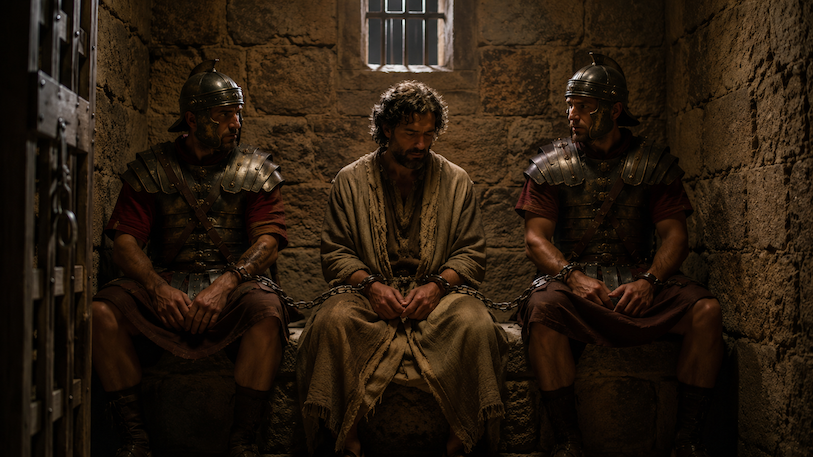
Verse 6 also says some of the sentries were stationed outside his detention chamber. So, even if he somehow escaped his chains, he still had to get past the guards at his cell doorway.
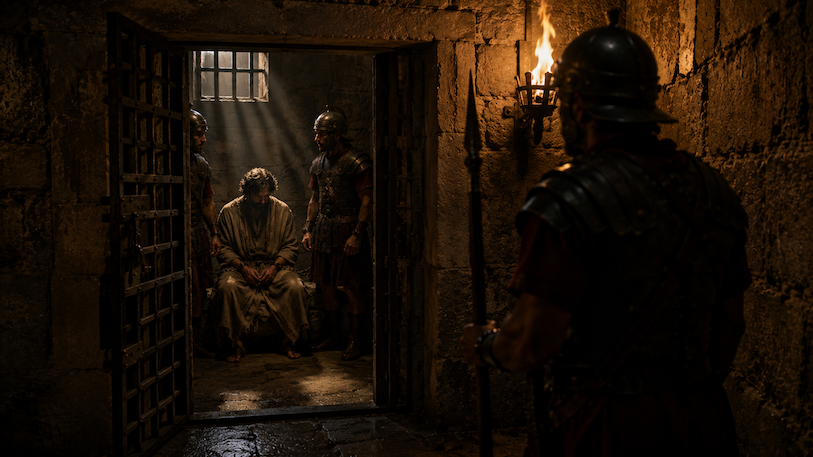
Verse 10 says that after the guards at his cell doorway, there were first and second guards. Think of this as multiple checkpoints of prison guards, as in, Peter was buried under layers of security.
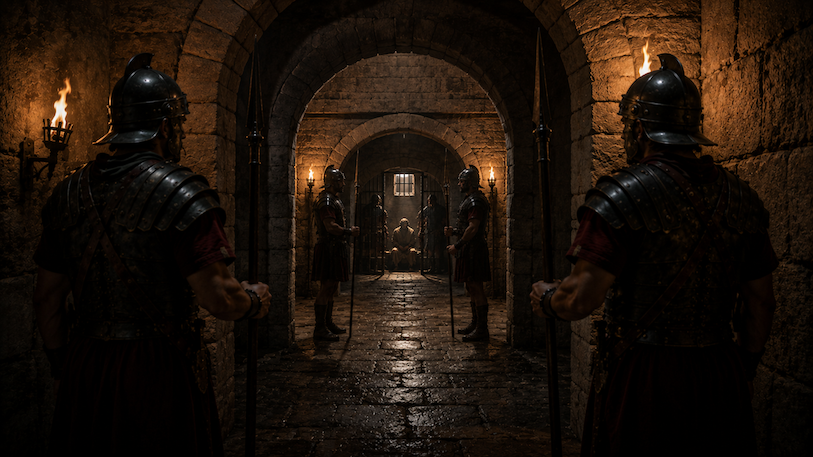
Verse 10 also says the last security checkpoint was the “iron gate leading to the city.” So, this is most likely the outer gate to the prison complex. Picture in your mind’s eye a heavy, massive, iron, locked and guarded gate.
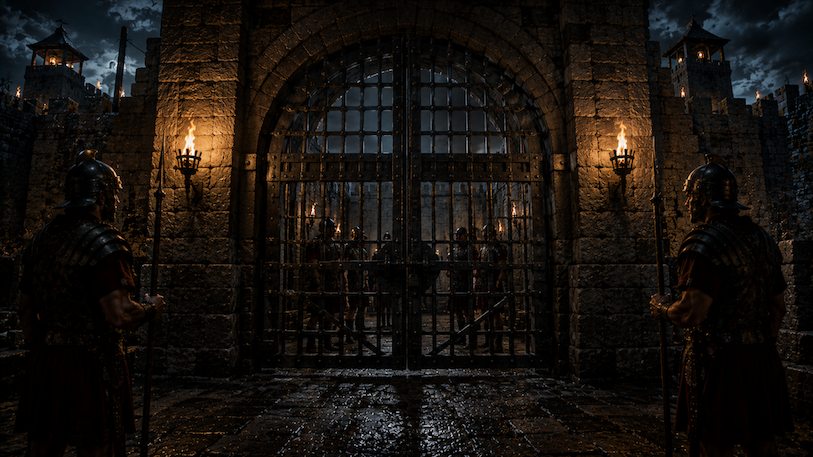
You know what all this security says? “You are not getting out, and no power on earth is going to pull off a prison escape!” It is designed to keep Peter contained so he is ready and available for a trial that will lead to a beheading the next morning.
So how does the church respond to such a troubling crisis threatening not only Peter’s life, but also the well-being of the new church?
Verse 5 says, “…but the church was earnestly praying to God for him.”
In other words, While the prison was operating, prayer was operating. While soldiers were standing watch, the church was standing watch spiritually.
Listen, the church's greatest weapon against impossible circumstances is not having more influence, it is not having more resources, nor is it getting your preferred Christian candidate in the Oval Office.
The church’s greatest weapon is passionate, persistent, and united, heaven-focused prayer.
When verse 5 says, “…the church was earnestly praying to God…,” the Greek word used there is (ektenōs). It means intense effort, sustained exertion, passionate persistence. It is prayer that is stretched to its limit. In fact, it is a comparative word used of Jesus in Luke 22:44 in the Garden of Gethsemane when it says, “Being in agony, He prayed more earnestly.”
If you recall that account, Jesus was so intensely burdened and so desperately dependent on God in prayer that His sweat was like blood; that is how intensely the church is praying here in Acts.
Here is what all that means: the church was praying with an intensity that did not give up after 30 minutes, or after one prayer meeting. They were focused, they were faith-filled, and they persisted, hour after hour, and day after day.
I don’t mean to belabor this point, but do you think the church in Nigeria, or in America is under any kind of pressure today? Consider what is happening in Colorado. Two Catholic churches and their preschools are challenging a requirement that schools receiving government preschool funding admit children without discrimination based on sexual orientation or gender identity, including those characteristics in their families. The churches argue that this conflicts with their religious admission policies and convictions about marriage and sexuality. The state says it is protecting equal access. That dispute has now reached the United States Supreme Court.
And here in Nigeria, where I live in Jos, Plateau State, the pressure can take a much more immediate and dangerous form. Churches in vulnerable communities across the state continue gathering for worship under the shadow of possible attacks by armed groups. Some congregations have lost members, pastors, homes, and church buildings. Others have continued worshipping in temporary shelters after being displaced. For these believers, gathering on a Sunday means carrying a real concern for their safety alongside their commitment to worship God.
The fact is, pressure does not always arrive as soldiers (or terrorists) at the church door. Sometimes it comes through financial conditions, legal disputes, and difficult decisions about how to remain faithful.
Now let me bring that even closer to home: Has your home church been feeling any kind of pressure in recent months? Have you been experiencing pressure in your life, in your family, or with your finances?
So, here’s the question: in light of how we just defined earnest prayer, how intensely have you been engaged in prayer about the pressure you are facing?
I don’t know what your personal prayer life is like, or what prayer looks like for your church community, but I’ll tell you what: if you want to see heaven-sent transformation, expedited angelic intervention in your earthly affairs, then you will need to build time into your schedule to come together with other like-minded believers and pray intensely like the life of the church depends on it.
In fact, this naturally leads into our next point about how to pray when the church is under pressure…
2. Pray in Community (Acts 12:1-5)
One of the patterns you will discover throughout both Scripture and church history is this: God may begin a revival burden with the prayer life of one person, but revival most often breaks out when God’s people gather in united, persistent, and intense prayer!
In Acts 1–2, the Day of Pentecost was preceded by believers gathering together in prayer.
In Acts 13, the sending of Paul and Barnabas into the Gentile world as missionaries was preceded by prayer and fasting among the leaders of the church.
Here in Acts 12, Peter’s supernatural deliverance was preceded by a church prayer meeting.
The 1857 Businessmen Revival in Manhattan, led by Jeremiah Lanphier, was birthed in prayer gatherings.
In 1904, the Welsh Revival, that is often associated with Evan Roberts, was actually fueled by passionate prayer meetings across Wales.
More recently, in 2023, the spiritual outpouring at Asbury University began in a chapel service and continued for sixteen days as thousands gathered for prayer, worship, confession, and testimony.
Here's my point: Before revival and spiritual breakthrough transform an entire city, it usually starts in the hearts of God’s people who are gathered together to seek His face!
I am jumping ahead here, but it is a significant note that after Peter is supernaturally released from prison, the first place he goes to in verse 12 is to the house of one of the church members, where it says “…many people had gathered and were praying.”
So, aside from the Sunday morning prayers we pray to transition from one part of the service to the next, where else, and with whom else, are you regularly gathering to seek heaven’s intervention?
Please hear my heart. It’s not a judgment; it’s an invitation. In fact, let me offer you some low-hanging fruit:
Who are one or two people you can regularly gather with to intercede on behalf of the church, on behalf of the lost in your community, or on behalf of the pastoral search?
Fathers and husbands, how can you start, however slowly, gathering your family together and praying for them and with them? It has been said that “If your day is hemmed in with prayer, it is less likely to come unraveled.”
I know of several churches in the United States, who at the present moment are in the middle of a pastoral search for its new pastor. I understand that during transitional periods in the life of a church, it’s very easy for the church to look expectantly for a dynamic new pastor to come and turn everything around. Or, on a larger scale in society, we may be hoping the right Christian leader will finally be elected into the highest office and reverse the moral tide of our culture.
But let me let you in on a secret:
there is no super-savior coming other than Jesus Christ!
And until He returns, God has determined that His church is His primary instrument of change in the world. In other words, stop waiting for the cavalry to come save the day...
You are the cavalry.
When heaven is preparing to move, God does not first look for someone with a big platform; He looks for a prayer meeting, a gathering of His people whose hearts are sold out to Him, and in His sovereign will, He chooses to bind many of His extraordinary works on earth to the ordinary prayers of His people. As one pastor famously noted, “There has never been a spiritual awakening in any country or locality that did not begin in united prayer.”
This brings us then to our last point about how to pray like your life depends on it.
3. Pray Expectantly (Acts 12:6-10)
Verse 6-10, “The night before Herod was to bring him to trial, Peter was sleeping between two soldiers, bound with two chains, and sentries stood guard at the entrance. 7 Suddenly an angel of the Lord appeared and a light shone in the cell. He struck Peter on the side and woke him up. “Quick, get up!” he said, and the chains fell off Peter’s wrists. 8 Then the angel said to him, “Put on your clothes and sandals.” And Peter did so. “Wrap your cloak around you and follow me,” the angel told him. 9 Peter followed him out of the prison, but he had no idea that what the angel was doing was really happening; he thought he was seeing a vision. 10 They passed the first and second guards and came to the iron gate leading to the city. It opened for them by itself, and they went through it. When they had walked the length of one street, suddenly the angel left him.”
So, an angel has shown up in Peter’s cell in the middle of the night and lit up the room. One of the clearest indicators of the impact of the church praying is not only the angel’s appearance, but also that little statement in verse 6 where it says, “…Peter was sleeping between two soldiers.”
That’s an incredible statement when you consider what Peter already knew. He knew what had happened to James. He knew what had happened in the arrest of other church leaders, and he most certainly knew what was going to happen to him in the morning: he was scheduled to die.
So, how in the world is Peter able to sleep so peacefully? In fact, verse 7 says he was so sound asleep in chains that the angel had to “strike” him to wake him up (that’s the closest thing to describing being punched).
I propose to you this answer: Peter was able to close his eyes because the church refused to close theirs.
When you lie down at night, you do so peacefully because you trust your door lock or security system you’ve put in place, right? In the same way, Peter was able to sleep soundly because someone else was keeping watch. And we know from verse 5 that from the moment of his arrest, “…the whole church was earnestly praying to God for him.”
He slept soundly because “the prayers of the righteous availeth much” (James 5:16). Prayer is powerful and effective because the prayers of God's people have a way of producing supernatural peace, even when the circumstances themselves have not yet changed.
Now, what I actually want to draw our attention to is Peter’s reunion with the church after his escape, because it is both humorous and instructional in the way it plays out.
The number one prayer point on the church’s prayer list would have been the release of Peter, right? Yet, when the answer to their prayers shows up at their front door, there is confusion, disbelief, and a bit of comedy playing out. Verse 13 says when a servant girl named Rhoda answers the knock on the door and hears Peter’s voice, in her excitement, she doesn’t think to open it, but excitedly runs to tell everyone else that their prayers have been answered.
So, let’s give her an A+ for enthusiastic faith, but a C- for logistics. Peter has escaped sixteen soldiers, two chains, multiple guard posts, and an iron gate, but he is nearly defeated by the church's receptionist.
Now, the church, on the other hand, gets a C grade for their response to her announcement. They say in verse 15, “You’re out of your mind,” they told her. When she kept insisting that it was so, they said, “It must be his angel.”
So, they have enough faith to believe an angel broke him free from prison, but they don’t have enough faith to believe the angel remembered to bring him back to them??
Here is my point: Peter’s miraculous deliverance did not happen because the church had perfect faith; the miracle happened because they prayed to a perfect God (who factors in our imperfect faith when we call out to Him).
So, when I talk about praying expectantly, our hope and expectation in prayer is not anchored in the size of our faith, or the length of our prayer, or even the intensity and volume of our prayer. Rather, our hope and expectation in prayer is anchored in the size of our great God.
The power of our prayer when we come together does not rest in our prayers, but in the One who hears our prayers! It’s for this reason that, should we find ourselves in a season when the church is under pressure, we must pray like our lives depend on it.
Let me end with this: The timeline between Peter’s arrest and his release appears to span over a few days, because it happened during the Festival of Unleavened Bread, and Peter was scheduled for trial after the Passover. And during those few days, we are told the church prayed earnestly.
Here is what I want to pull out of that:
The church prayed for days, but Peter’s deliverance only took minutes.
Listen, when you and I devote our lives to persistent, communal, and expectant prayers, God is often pleased to accomplish in a few moments what ordinarily would have taken His people months or years to accomplish in their own strength!
The church prayed for days, but heaven only required a few minutes to remind Herod, and everyone else, who truly sat on the throne.
May we make space in our lives and in our church for God to sit enthroned in our prayers!

Husband. Dad. Pastor. Nigerian American. Storyteller. Aspiring Prayer Warrior. Steak Lover. Follower of Jesus Christ reminding you that God the Father still loves you.